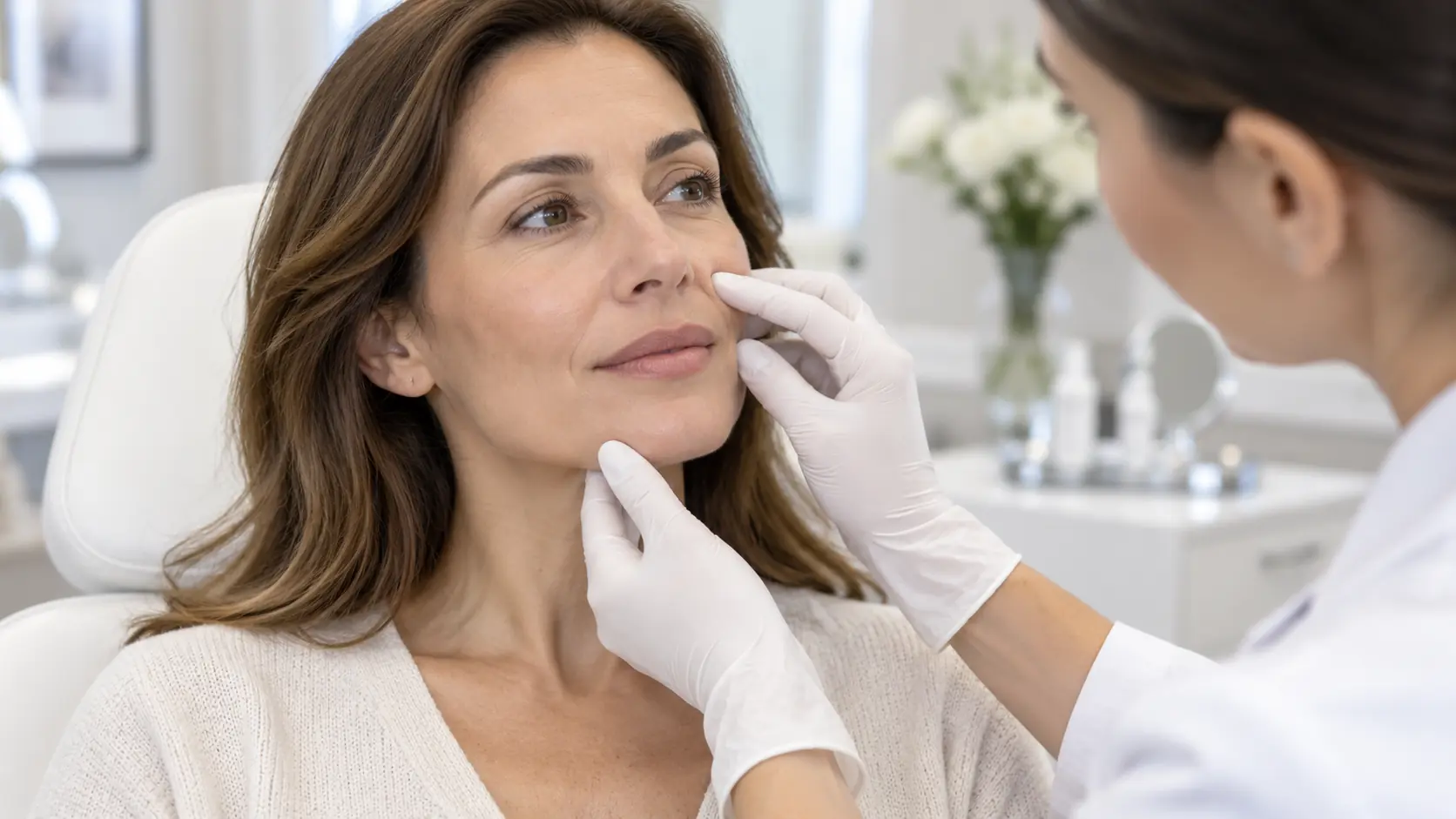
Facial vitamin injections: what they are, their benefits and when they are worth it
Dr Eva Garrigós · 3 June 2026

There are times when your skin is not “bad”, but it does not look the way you would like either. It feels dull, thinner, uneven in texture, a little dehydrated or has that tired look that does not go away with a bit more sleep or a change of cream. In those cases, many people start looking for treatments that bring radiance, hydration and a healthy glow without changing their features. And that is where facial vitamin injections come in.
This treatment, also known as revitalising facial mesotherapy or a vitamin cocktail for the skin, aims to improve skin quality from within through small injections of active ingredients chosen according to the needs of each face. It is not a filler, it does not aim to change volumes and it is not meant to “transform” you. Its goal is much subtler, yet very appealing: to help the skin look fresher, plumper, more rested and well cared for.
At Dr Garrigós Clinic we approach this kind of treatment from a medical, personalised and natural perspective. Because, even though people talk about “vitamins” in general terms, not every skin needs the same thing, and not every protocol makes the same sense.
What people interested in this facial treatment are really looking for
When someone asks about facial vitamins, they are not usually looking for a radical change. What they tend to want is to look better without it being obvious that they have “had something done”. That is the key.
Often the concern is not a particular wrinkle or an isolated mark, but a general feeling: “I look unwell”, “my skin is dull”, “it used to have more glow”, “I wear make-up and still look tired”. Sound familiar? It is a very common consultation.
People who look for this treatment usually want to:
- Restore radiance.
- Improve deep hydration.
- Soften texture and fine lines.
- Prepare the skin before an event.
- Maintain a fresh look as part of a well aging routine.
- Avoid treatments that are too noticeable.
And here it is worth clarifying something important: facial vitamins are no substitute for a full medical-aesthetic diagnosis. They can be an excellent tool, yes, but only when the active ingredients, technique and frequency are chosen well. Sometimes the skin needs hydration; at other times, oil control; at others, treatment for pigmentation; and at others, a combination of treatments to achieve a beautiful, coherent result.
What they are and how they work on the skin
Facial vitamin injections involve applying small amounts of revitalising substances to the superficial or middle layers of the skin, usually through micro-injections. The aim is to bring certain active ingredients closer to the area where we want to improve skin quality.
We are not only talking about vitamins in the strict sense. Many protocols may use combinations of vitamins, minerals, amino acids, antioxidants, non-cross-linked hyaluronic acid, coenzymes and other hydrating and regenerating actives, always according to a prior medical assessment.
The idea is to improve the skin’s environment so that it looks more hydrated, radiant and even. It is not magic, of course. The skin still depends on many factors: genetics, rest, sun exposure, diet, stress, smoking, skincare routine… But a well-indicated treatment can make a noticeable difference to that well-cared-for look.
The difference between vitamins, facial mesotherapy and skinboosters
It is normal to be confused, as similar terms are often used. Let us clear things up.
Facial vitamins usually refer to revitalising cocktails with active ingredients designed to improve radiance, hydration and skin quality.
Facial mesotherapy is really the technique: small micro-injections into the skin to deliver specific active ingredients. In other words, vitamins can be applied by means of facial mesotherapy.
Skinboosters, for their part, tend to focus more on providing deep hydration with lightly cross-linked hyaluronic acid or formulations designed to improve elasticity and texture, without creating volume like a classic filler.
Put simply: not everything injected to improve the skin is the same. The brand or popular name matters less than the diagnosis and the actual composition of the treatment.
Which active ingredients can be used depending on the state of the skin
Skin that is dull from stress does not need exactly the same as thin, dehydrated skin with its first wrinkles. That is why, before choosing a protocol, we assess the real condition of the skin.
Depending on the case, active ingredients can be selected with different goals:
- Antioxidant vitamins, to support radiance and combat a tired appearance.
- Amino acids, which help improve the look and overall quality of the skin.
- Non-cross-linked hyaluronic acid, for deep hydration without a filler effect.
- Minerals and cofactors, which may form part of revitalising cocktails.
- Depigmenting or regulating actives, if there is uneven tone or mild pigmentation.
- Gentle biostimulating substances, in specific cases of early laxity or thinner skin.
What matters is not to “put in everything”, but to use what your skin needs. Sometimes less is more, and in aesthetic medicine that really shows.
Why not all revitalising cocktails are the same
This is one of the most important points. Two treatments can both be called “facial vitamins” and be very different from each other. The composition, concentration, product quality, application technique, depth, number of injection points, frequency and, of course, medical judgement all vary.
That is why we do not like to treat it as a standard “copy and paste” treatment. Young skin lacking glow should not be treated in the same way as mature skin with dehydration, early laxity and uneven texture.
We also need to take into account the time of year, whether you have had a lot of sun, whether there is inflammation, whether you bruise easily, whether you are pregnant, whether there is an active skin condition or whether you have had other recent aesthetic treatments.
What they are for: the main benefits for the face
Facial vitamins are mainly used to improve skin quality. They are not a facelift, they do not remove deep pigmentation overnight and they do not replace treatments such as neuromodulators, fillers or laser when these are indicated. But when properly planned, they can be a very useful tool within a facial treatment plan.
More radiance for dull or tired skin
One of the most sought-after benefits is recovering the glow that skin loses through stress, lack of rest, sun, hormonal changes or simply the passing of time.
When skin is dull, exfoliating or changing serum is often not enough. There may be dehydration, micro-inflammation, a compromised skin barrier or poor cell renewal. A revitalising protocol can help the face look fresher, more rested and more even.
Deep hydration and improved texture
Hydration from a cream is important, but it does not always reach where we want it to. When we use actives such as non-cross-linked hyaluronic acid, we aim to improve hydration from the deeper layers of the skin, without adding volume.
This can translate into a smoother texture, less tightness and a plumper feel to the skin. It is particularly worthwhile for people who say: “I put on cream and soon afterwards my skin feels dry again”. That detail tells us a great deal.
Preventing premature ageing
The well aging approach is not about waiting for marked signs to appear before acting. It is about caring for the skin in an intelligent, gradual and natural way.
Facial vitamins can form part of a preventive plan when the skin begins to show signs of tiredness, loss of radiance or its first fine lines. It is not about “freezing” the face or chasing perfect skin. It is about keeping skin healthy, hydrated and looking good for longer.
Support for fine lines, early laxity and loss of elasticity
Fine lines caused by dehydration usually improve when the skin regains water and elasticity. We are not talking about erasing deep folds, but about softening that crêpey or surface-wrinkled appearance.
In cases of early laxity, it can be useful as a support, especially when combined with other biostimulating or device-based treatments if the diagnosis calls for it. Here we have to be realistic: if laxity is marked, vitamins on their own will fall short.
Improving uneven tone and a tired appearance
Some cocktails can help improve the appearance of uneven tone, especially when the problem is related to dull skin, mild photoageing or a lack of uniformity. If there is deep pigmentation, melasma or significant pigmented lesions, it will be appropriate to consider specific treatments such as depigmenting peels, laser, intense pulsed light or prescribed medical skincare.
The key is not to confuse “I want more glow” with “I want to get rid of pigmentation”. They are similar, but they are not always treated in the same way.
When they can be a good option
Facial vitamin injections can be a good option when we want to improve skin quality without changing your expression or adding volume. They are also a good choice when we want a gradual, discreet treatment that fits in with normal life.
Dehydrated skin that lacks glow or looks dull
If your skin looks dry even though you use cream, if your make-up cracks, if you feel tightness or if you simply feel your face has lost its freshness, this treatment can make a lot of sense.
That said, it is worth first assessing whether the skin barrier is compromised, or whether there is sensitivity, rosacea, active acne or any condition that needs treating first. It is not just a matter of injecting and that is that.
Before an important event or a change of season
Many people request it before a wedding, a celebration, a photo shoot or a time when they want to look especially good. It is also very worthwhile at the change of seasons, when the skin has taken a beating from the sun or looks dull after winter.
Ideally, do not have it the day before an event. Although the procedure is usually well tolerated, small marks, redness or bruises may appear. It is better to plan ahead.
As a well aging maintenance treatment
Within a well aging approach, facial vitamins can be used as maintenance to look after skin quality throughout the year. Sometimes we are not looking to correct, but to maintain. And that difference matters.
Well-hydrated skin that is protected from the sun and treated consistently ages differently. That does not mean it does not age, of course, but it tends to do so with better texture and more balance.
After periods of stress, sun or lack of rest
There are times when the skin “pays the price”: work stress, little sleep, travel, sun exposure, changes in routine, a poorer diet than usual… And yes, it shows on your face.
At those times, a revitalising protocol can help the skin recover, always alongside good habits and a suitable skincare routine. Because it is worth saying: no treatment fully makes up for months of poor sleep, but it can help improve the starting point.
How the treatment is carried out, step by step
Although it is a relatively simple procedure for the patient, it must be performed with medical judgement and in an appropriate setting. The steps may vary depending on the protocol, but they usually follow a similar structure.
Prior medical assessment and skin diagnosis
Before starting, we analyse your skin, your goals, your medical history and any previous treatments you have had. We also check for contraindications or whether the skin should be prepared beforehand.
This part is key. The diagnosis makes the difference between a correct treatment and one that is simply “on trend”. And in aesthetic medicine, following trends without assessing the case usually ends in poor or unnatural results.
Preparing the area and application technique
The skin is carefully cleansed and disinfected. In some cases an anaesthetic cream may be applied if the person is more sensitive, although the treatment is often well tolerated.
Micro-injections are then made at strategic points on the face. The technique can vary: small superficial papules, multi-puncture, application to particularly dehydrated areas or an overall approach to the face. It depends on the product and the goal.
Session length and what you feel during the procedure
The session is usually quick. Including preparation, assessment and application, it is generally a comfortable procedure that is easily carried out in the clinic.
During the treatment you may feel small pricks, a slight stinging sensation or pressure in some areas. It is not usually intensely painful, but it can be somewhat uncomfortable in more sensitive areas, such as around the mouth or near the nose.
Aftercare to optimise the result
After the treatment, we recommend following a few simple guidelines so the skin recovers well:
- Do not touch or massage the area for the first few hours.
- Avoid make-up immediately afterwards, unless advised otherwise.
- Do not do intense exercise that day.
- Avoid saunas, swimming pools or excessive heat for 24–48 hours.
- Use high sun protection.
- Follow the skincare routine recommended by the medical team.
It may seem basic, but this aftercare makes a big difference. Sometimes the result does not depend only on what we do in the clinic, but also on how you look after your skin afterwards.
Results: when they show and how long they last
The results of facial vitamins are usually gradual. Some people notice their skin is more hydrated and radiant within a few days, while others need several sessions to see a clearer change.
What changes can be seen after the first session
After the first session, it is usual to notice the skin looking somewhat fresher, more hydrated and better overall. It is not always immediate, because the skin needs a few days to recover from the micro-injections and respond to the treatment.
The nicest result usually appears once the slight initial swelling settles and the skin begins to show more radiance. It is that “healthy glow” effect that does not look artificial.
How many sessions are usually recommended
It depends on the condition of the skin and the goal. In some cases a single session may be enough before an event or as a boost. In others, a protocol of several sessions a few weeks apart is recommended.
For example, very dehydrated or dull skin may need an initial plan followed by maintenance sessions. What matters is not to schedule sessions out of routine, but according to real need.
How often the treatment should be repeated
As maintenance, it can be repeated periodically depending on age, skin quality, sun exposure, habits and any combined treatments. Some patients include it at particular times of the year, such as after the summer or before busier seasons of events.
There is no universal frequency. In fact, we would be a little wary of any overly fixed recommendation made without assessing you first.
Is it a safe treatment?
When performed by qualified professionals, with suitable products and in a medical clinic, it is generally a safe treatment. Even so, like any procedure involving micro-injections, it can have side effects and it is not indicated in every case.
Possible normal side effects
After the treatment you may experience:
- Redness.
- Small papules or dots.
- Local tenderness.
- Mild swelling.
- Small bruises.
- A feeling of tightness or warmth.
These effects are usually temporary and resolve within a short time. Even so, we always explain what to expect and when to get in touch if something does not progress as it should.
Contraindications and cases in which it is not recommended
It may not be recommended in cases such as pregnancy or breastfeeding, active skin infections, cold sore outbreaks, uncontrolled skin conditions, allergy to any of the components, clotting disorders or certain medical treatments.
Very reactive skin, active rosacea or significant inflammation should also be assessed carefully. Sometimes the skin needs to be calmed first and revitalised afterwards. Going too fast is not always a good idea.
Why it should be carried out in a specialist medical clinic
Because it is not just “injecting vitamins”. You need to know facial anatomy, the layers of the skin, possible reactions, contraindications and the right technique. In addition, the product must be safe, correctly stored and suitable for medical-aesthetic use.
Safety begins long before the needle: it begins with the diagnosis, the indication and the choice of protocol.
How they differ from other facial revitalisation treatments
Facial vitamins are one option among a wide range of treatments to improve the skin. They do not compete with all of them; they often complement each other.
Vitamins versus injected hyaluronic acid
Injected hyaluronic acid can be used for different purposes. When used as a filler, it aims to add volume, project, correct folds or redefine areas. Facial vitamins or skinboosters with non-cross-linked hyaluronic acid, on the other hand, mainly aim for hydration and skin quality.
In short: one can change structure or volume; the other usually improves the skin without changing your features.
Vitamins versus chemical peels
Peels work mainly on the surface of the skin through controlled chemical exfoliation. They are very useful for texture, pigmentation, acne, pores, radiance and skin renewal.
Vitamins work differently, delivering active ingredients through micro-injections. If your skin needs surface renewal, a peel may be better. If it needs deep hydration and revitalisation, vitamins may be more suitable. And in many cases, combining them well can give a more complete result.
Vitamins versus Dermapen or device-based treatments
Dermapen, radiofrequency, laser, intense pulsed light and other device-based treatments can stimulate the skin through microchannels, heat, light energy or specific mechanisms. Vitamins, on the other hand, deliver specific active ingredients by injection.
It is not a question of choosing “the best” in the abstract. The right question is: what your skin needs right now. Sometimes it will be stimulating collagen, sometimes hydrating, sometimes treating pigmentation and sometimes combining.
When to combine them to enhance results
We can combine vitamins with peels, hydration treatments, biostimulation, neuromodulators, hyaluronic acid, medical facial cleansing or device-based treatments, provided there is proper planning.
The order matters. The intervals between treatments matter. And the skin also needs rest. That is why we like to design realistic, gradual protocols, not impossible schedules packed with procedures.
Common mistakes before choosing a revitalising treatment
Before deciding, it is worth avoiding some very common mistakes. We see them often, and that is fine; it is precisely why we place so much emphasis on the prior assessment.
Thinking that all skin needs the same thing
Your friend may have had vitamins and be delighted, but that does not mean your skin needs the same cocktail. Perhaps you need to treat pigmentation, repair the barrier, control acne or improve laxity.
Personalised aesthetic medicine starts by accepting that every skin has its own story. And yes, it may sound obvious, but it is very often forgotten.
Looking only for a “healthy glow” without treating the cause
A healthy glow is lovely, of course. But if the skin is dull because of a lack of hydration, sun damage, stress or an unsuitable skincare routine, we need to understand the cause.
If we only treat the symptom, the result may not last long. On the other hand, when we combine medical treatment, home care and sensible habits, the skin responds better.
Choosing on price rather than medical diagnosis
Price matters, of course. But choosing a facial treatment purely because it is cheaper can prove costly if the product is not suitable, the technique is not correct or there was no indication for it.
With injectable treatments, trust, safety and medical judgement are essential. You are not buying an ampoule; you are entrusting your skin and your face to a professional.
The price of facial vitamins: what it depends on
The price of facial vitamins can vary depending on several factors. Not all treatments have the same composition or require the same number of sessions.
Type of active ingredients used
A simple revitalisation protocol does not cost the same as one with more specific actives, non-cross-linked hyaluronic acid, antioxidant complexes or more advanced products.
In addition, the quality and traceability of the product are important. In a medical clinic we work with appropriate materials selected with care, not with improvised mixtures.
Number of sessions needed
Slightly dull skin may need a single session. More dehydrated, photoaged skin or skin with more altered texture may benefit from a plan of several sessions.
That is why, before talking about a fixed price, it is worth assessing the case. That way we avoid recommending too much or too little.
Combination with other personalised treatments
Sometimes vitamins form part of a broader protocol: medical facial cleansing, peel, Dermapen, neuromodulators, biostimulation or deep hydration treatments.
When we combine treatments, we do not do it to pile them up, but to act on different layers or needs of the skin. When well planned, the result can be much more natural and longer-lasting.
Frequently asked questions about facial revitalisation with vitamins
Does the treatment hurt?
It is usually well tolerated. You may feel small pricks or a mild stinging sensation, but it is not normally a particularly painful procedure. For sensitive people, topical anaesthetic can be considered.
Does it leave marks on the face?
It may leave slight redness, small dots or the odd bruise. These usually disappear within a short time. Even so, if you have an important event, we recommend allowing plenty of time and not having it the day before.
Can it be done in summer?
In many cases yes, provided sun protection guidelines are followed and the skin is not irritated or freshly sunburnt. If there is pigmentation, melasma or intense sun exposure, we will assess the best timing and whether another protocol would be more suitable.
Is it suitable for young skin?
Yes, it can be useful for young skin with dehydration, a lack of radiance or a tired appearance. There is no need to wait for marked wrinkles before looking after your skin. That said, with young skin we usually opt for gentle, preventive and very carefully indicated protocols.
Is it compatible with Botox, hyaluronic acid or peels?
In many cases yes, but the timing has to be well organised. Vitamins can complement neuromodulators, hyaluronic acid, peels or skin-stimulating treatments. The key is to plan the right order to avoid irritation, interference or unbalanced results.
Personalised facial treatment at Dr Garrigós Clinic
At Dr Garrigós Clinic we see facial vitamins as part of an overall approach to skincare. We do not look for exaggerated results or generic protocols. We want you to look better, naturally, respecting your face and your stage of life.
Prior diagnosis to choose the right protocol
Before recommending a treatment, we assess your skin, your habits, your expectations and your real needs. Sometimes vitamins are a great option. At other times it is better to start with a medical facial cleanse, a peel, a skincare routine, a depigmenting treatment or a combined strategy.
The diagnosis avoids wasting time and money on treatments that do not tackle the root of the problem.
A natural, gradual approach tailored to each skin
We like to work towards gradual, elegant and coherent results. The skin does not need to look like someone else’s; it needs to look healthier, more balanced and more radiant.
That is why we tailor the active ingredients, technique and frequency to each person. Because preparing the skin before a wedding is not the same as restoring sun-damaged skin or maintaining a long-term well aging plan.
When to ask for a personalised medical assessment
We recommend booking an assessment if your skin looks dull, dehydrated, uneven in texture or is showing its first fine lines, or if you simply want to know which facial treatment suits you best.
It is also a good idea to come in if you have been trying skincare products for a while without seeing clear changes. Sometimes it is not that the cream “does not work”; it is that the skin needs a different kind of stimulus or a more complete approach.
Facial vitamin injections can be an excellent option when they are properly indicated. And that is the key: not doing more for the sake of it, but doing what is right for your skin.
[googlesitekit-end-of-content]